When consumers pop a bottle of bubbly, they often expect “Extra Dry” to be bone-dry, only to discover a soft, fruit-forward sweetness. Understanding sparkling wine sweetness requires looking beyond label terms to examine the biochemistry of residual sugar, acidity, and sensory perception.
1. How Sweetness Gets into the Bottle: The Dosage Process
In traditional-method sparkling wines (such as Champagne, Cava, or Cap Classique), primary and secondary fermentations consume almost all natural grape sugars (glucose and fructose), leaving the base wine completely dry (usually <2 g/L residual sugar).
The final sweetness is precisely calibrated at the end of the process through disgorgement and dosage:
1.Disgorgement: The frozen dead yeast cells (lees) are expelled from the neck of the bottle.
2.Liqueur d’Expédition (Dosage): Before recorking, winemakers top off the bottle with a mixture of base wine and sucrose (cane or beet sugar) or concentrated grape must.
3.The Chemical Transformation: Once introduced, enzyme activity (specifically invertase naturally present in wine or yeast remnants) hydrolyzes sucrose into its monosaccharide constituents: glucose and fructose.
Why Fructose Matters: Fructose tastes roughly 1.7 times sweeter than glucose to human taste receptors (T1R2/T1R3). This means the choice of dosage sugar directly impacts how sweet the wine tastes on the palate, even at identical sugar concentrations.
2. The Official EU Sweetness Scale (EU Regulation 2019/33)
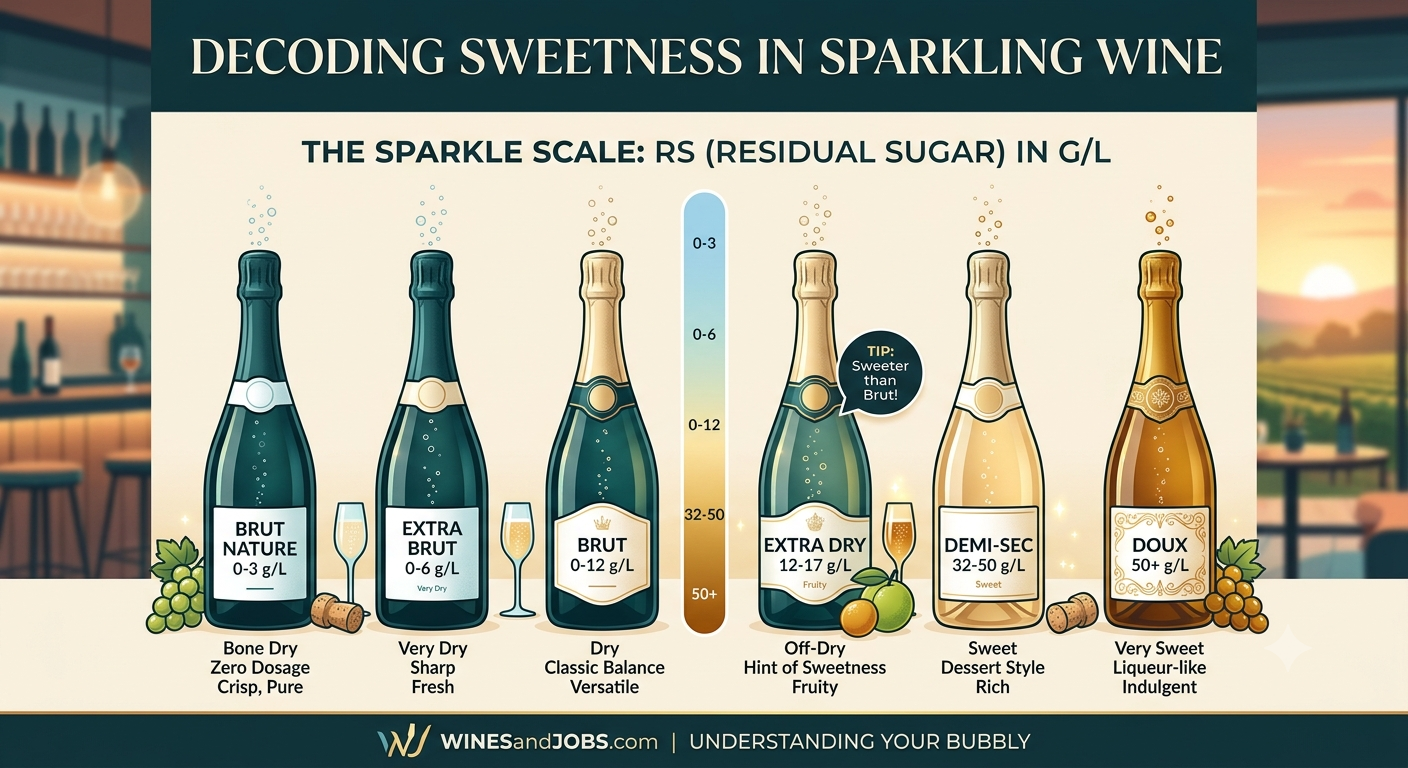
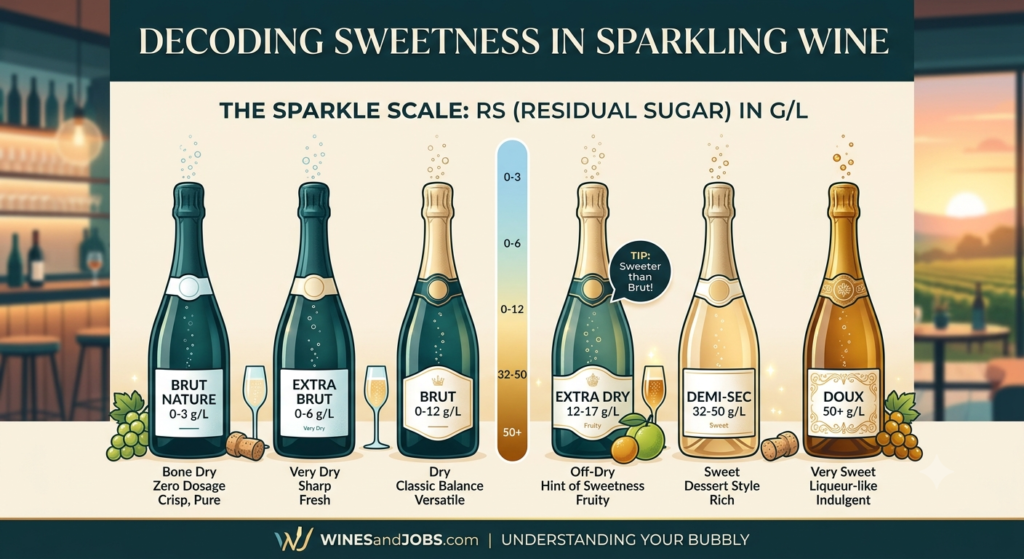
European law—and global winemaking standards—strictly categorize sparkling wine by Residual Sugar (RS) measured in grams per liter (g/L).
Note: EU law allows a ±3 g/L legal tolerance buffer between label categories to account for naturally occurring analytical variations in bottle aging.
Label Term
Residual Sugar (g/L)
Sugar Per Glass (∼150 mL)
Sensory Profile & Science
Brut Nature(Pas Dosé / Zero Dosage)
0 – 3 g/L
< 0.5 g
Bone Dry. Zero dosage added. High acid, stark minerality, razor-sharp precision.
Extra Brut
0 – 6 g/L
< 0.9 g
Very Dry. Extremely crisp. Popular among sommeliers and purists seeking raw terroir.
Brut
0 – 12 g/L
0 – 1.8 g
Dry & Balanced. The global standard. Slight dosage softens sharp malic and tartaric acids.
Extra Dry(Extra Sec)
12 – 17 g/L
1.8 – 2.5 g
Off-Dry. Noticeably softer with ripe fruit perception. Common in Prosecco.
Sec(Dry / Trocken)
17 – 32 g/L
2.5 – 4.8 g
Medium-Dry. Mild sweetness; prominent orchard and stone fruit flavors.
Demi-Sec
32 – 50 g/L
4.8 – 7.5 g
Sweet. Noticeable dessert-like sweetness. Pairs excellently with wedding cake or fruit tarts.
Doux(Dolce / Sweet)
> 50 g/L
> 7.5 g
Very Sweet. Rich and syrupy style. Rare today, but historically popular in 19th-century Russia.
3. Sensory Matrix: Why Sugar Doesn’t Act Alone
A wine with 10 g/L of sugar might taste bone-dry, while another with the exact same dosage tastes soft and sweet. Human perception of sweetness is governed by a tripartite sensory balance:
A. Total Acidity (TA) & pH Suppress Sweetness
Sparkling wine grapes are harvested early at high acidity (often 7 – 10 g/L.Total Acidity expressed as tartaric acid, with pH 2.9 – 3.1).
Mechanism: Hydrogen ions (H+) stimulate sour taste receptors, which send inhibitory signals in the central nervous system that mask sweetness signals from T1R2/T1R3 receptors.
Result: A high-acid Champagne with 8 g/L of sugar often tastes completely dry because the acid counteracts the sugar.
B. Carbonation (CO2) Adds Carbonic Acidity
Dissolved CO2 gas creates carbonic acid (H2CO3) when it interacts with water in saliva:
CO2 +H2O ⇌ H2CO3 ⇌ H+ + HCO–3
The tactile prickle of effervescence triggers trigeminal nerve pain/coolness receptors, further suppressing the perception of sweetness compared to still wine.
C. Ethanol & Glycerol Enhance Viscosity
Fermentation yields ethanol (typically 11.5–12.5% ABV) and glycerol (5 – 10 g/L). Both compounds bind mildly to sweetness receptors and increase fluid viscosity, contributing to a “round” or “sweet” mouthfeel even in low-dosage wines.
To explore more career opportunities, industry insights, and expert knowledge within the wine sector, visit winesandjobs.com, the leading platform connecting professionals with the resources they need to thrive. From specialized job listings to educational resources, our platform is dedicated to supporting your professional journey in the dynamic world of wine
We’d love to hear from you! Whether you have a question about job listings, wine industry insights, or business collaborations, our team is ready to help.

One Comment
I like this post, enjoyed this one thank you for putting up. “To affect the quality of the day that is the art of life.” by Henry David Thoreau.