


In the high-stakes world of harvest, the “crush” is the moment of truth. It is the first time the fruit enters the winery, and how you handle it here dictates the texture, aroma, and tannin profile of the finished wine.
For decades, the industry relied on basic centrifugal force. But in 2026, de-stemming has evolved into a high-tech discipline. Wineries are now choosing between mechanical precision and “gentle” vibration to protect fruit integrity. Here is the science behind the modern crush pad.
Why De-stem? The “Green” Factor
Grapes arrive at the winery as “clusters.” The stems (rachis) are rich in lignin and tannins, but unlike the ripe tannins in grape skins, stem tannins can be aggressively bitter and “green.”
- The Goal: Remove 99%+ of stem material while keeping the berries intact.
- The Risk: Broken berries lead to premature oxidation and “juicing” before the fruit reaches the fermenter.
The Contenders: Comparing Modern Technologies
1. Centrifugal (Rotary) De-stemmers
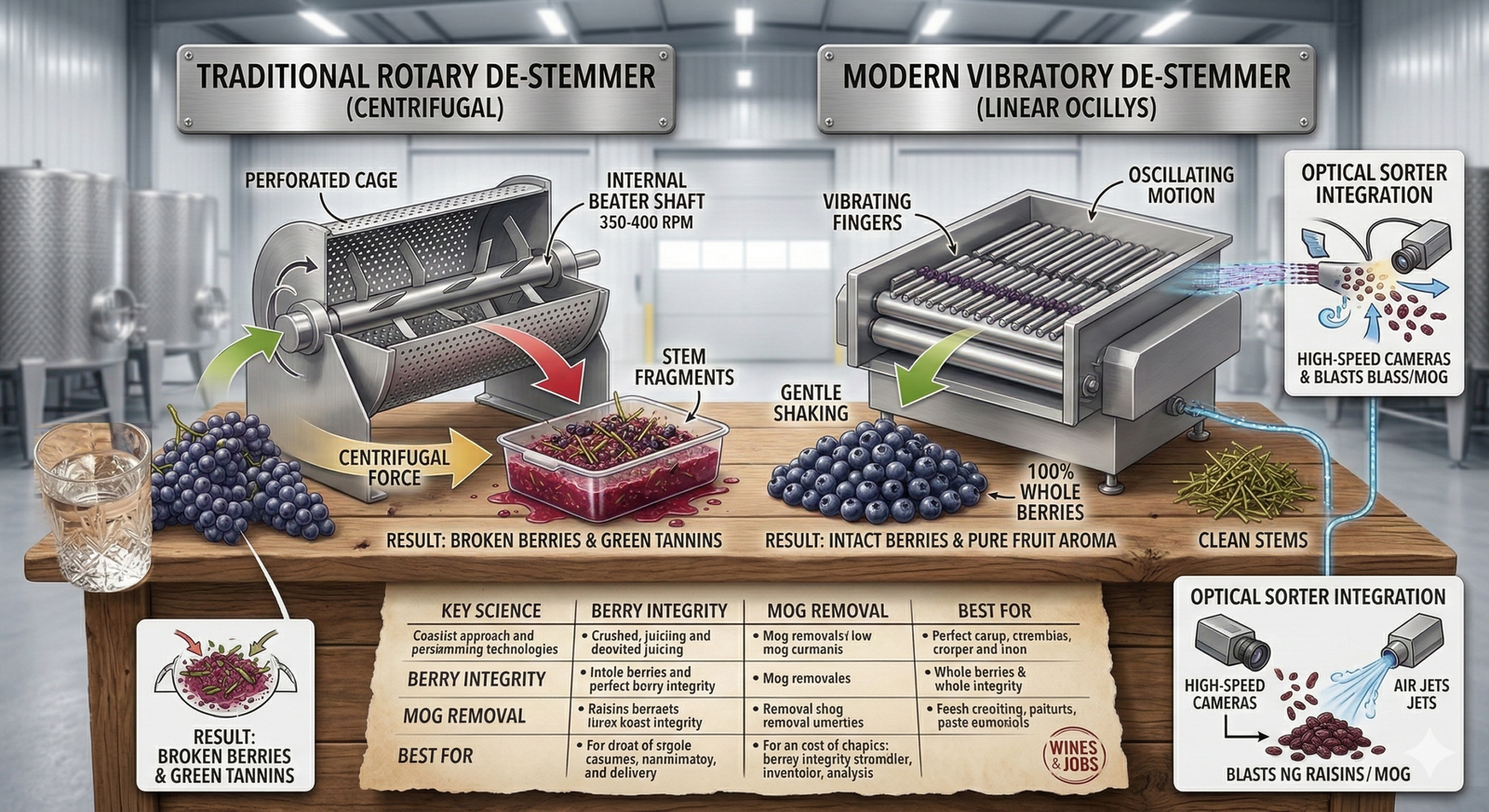
This is the workhorse of the industry. Grapes enter a perforated stainless steel drum where a rotating beater (shaft) knocks the berries loose.
- The Science: Traditional rotary systems rely on tangential shear. Recent mechanical modeling shows that lower speeds (350–400 RPM) actually yield higher detachment efficiency with less damage than high-speed centrifugal force.
- Best For: High-volume commercial production where throughput (10–50 tons/hour) is the priority.
2. Linear Vibration (Vibratory) Technology
Instead of a rotating cage, these machines use a series of vibrating fingers or rollers to “shake” the berries off the stems.
- The Science: Systems like the Bucher Vaslin Oscillys use high-amplitude oscillation. This mimics a “swinging” motion that detaches grapes without the harsh impact of a mechanical beater.
- Best For: Premium red varieties like Pinot Noir or Malbec, where preserving “whole berry” integrity is essential for aromatic complexity.
3. Optical Sorting Integration
In 2026, de-stemming is often just the first step. The fruit then moves to a “Blue Belt” where high-speed cameras (1,000+ frames per second) scan every individual berry.
- The Tech: Air nozzles blast away under-ripe berries, raisins, and “MOG” (Material Other than Grapes) in milliseconds.
- The Result: Near-perfect fruit purity that eliminates “green” notes and enhances mouthfeel.
Technology Comparison Table (2026)
| Technology | Top Brand Examples | Key Advantage | Best Varieties |
| Centrifugal | CME, Enoveneta | High throughput & cost-effective | Cabernet, Merlot |
| Vibratory | Bucher Vaslin Oscillys | Zero berry breakage | Pinot Noir, Syrah |
| Linear Roller | Pellenc Selectiv’ | Removes even tiny stem fragments | Grenache, Chardonnay |
| Optical | Bucher Vistalys, Pellenc Vision | 100% sorting accuracy | Flagship/Reserve wines |
The Winemaker’s Strategic Choice
The “Science of the Crush” has shifted from a one-size-fits-all approach to a spectrum of configurable solutions. Wineries now balance throughput with gentleness.
- Large Commercial Wineries: Prioritize high-capacity automated lines with integrated sorting to manage labor costs.
- Boutique Producers: Opt for compact, mobile, vibratory de-stemmers that offer professional-grade “gentle” processing at lower volumes (3–5 tons/hour).
🍷 Published on Wines and Jobs
Connecting the global wine community through insight, expertise, and opportunity.
As these sophisticated technologies become the industry standard, the demand for technicians and cellar managers who can calibrate and maintain them is skyrocketing. Explore the latest technical roles in winery operations on our job board.
- Find Your Next Technical Role: Browse Winery Operation Jobs
- Stay Informed: Join our community for more “Crush Pad” deep dives at www.winesandjobs.com.
Cheers !!!