
When we taste wine, we often get distracted by “flavor notes”—the smell of cherries, the hint of vanilla, or the scent of wet stones. But underneath those flavors lies the structure. If flavors are the paint and furniture of a house, structure is the foundation, the framing, and the load-bearing walls.
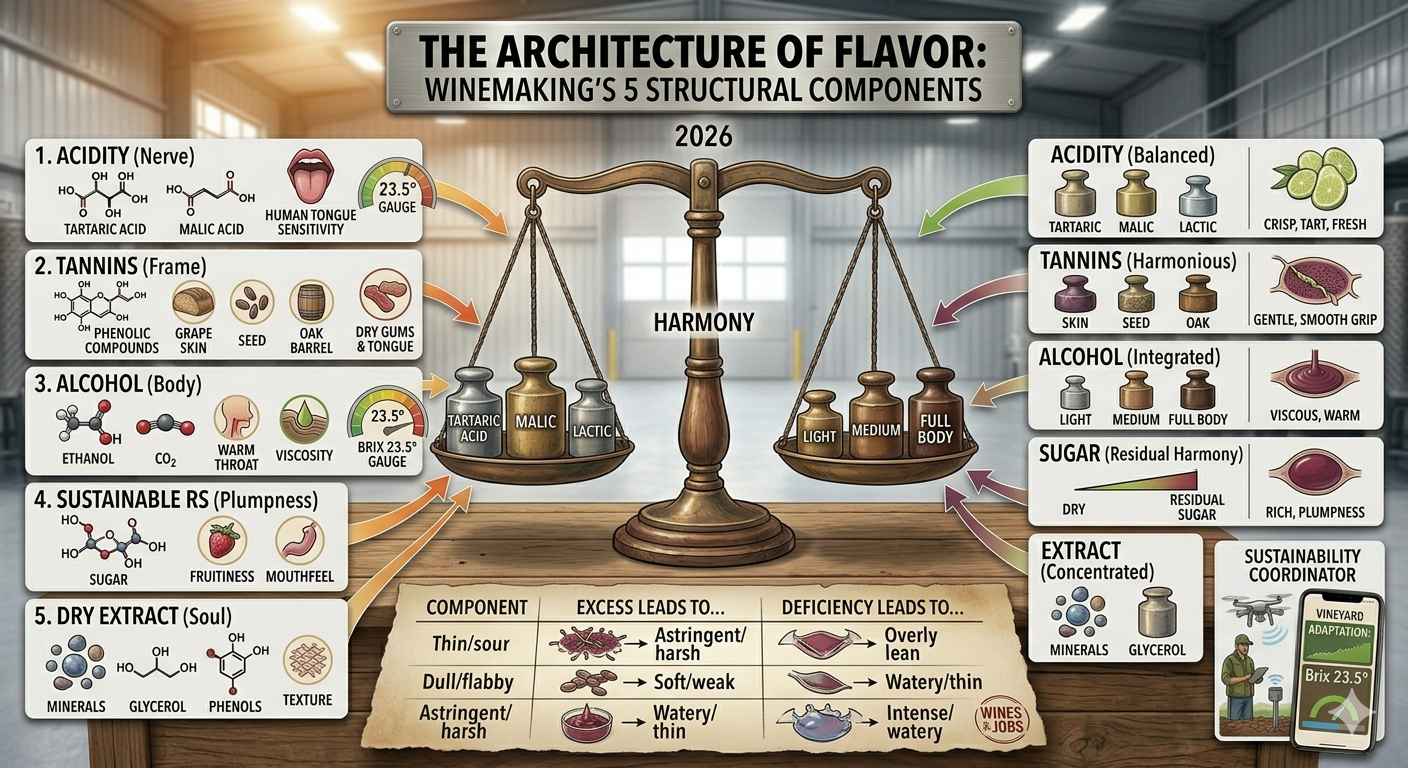
For anyone working in the industry—from cellar hands to sommeliers—understanding structure is essential. It’s the difference between a wine that is “balanced” and one that falls apart. Here are the five structural pillars of every bottle.
1. Acidity (The “Nerve”)
Acidity is what makes your mouth water. It provides freshness, lifts the fruit flavors, and acts as a natural preservative.
- The Sensation: You feel it on the sides of your tongue and in the back of your jaw.
- The Types: Primarily Tartaric (stable and strong), Malic (crisp, like green apples), and Lactic (soft and creamy).
- Role: High acidity makes a wine feel “energetic” and “bright.” Without it, wine tastes “flabby” and heavy.
2. Tannins (The “Frame”)
Tannins are phenolic compounds found in grape skins, seeds, and stems (as well as oak barrels). They are almost exclusively found in red wines.
- The Sensation: A drying, puckering feeling on your gums and tongue—similar to drinking over-steeped black tea.
- The Science: Tannins bind to the proteins in your saliva, essentially “drying out” your mouth.
- Role: They provide the physical “grip” and structure that allows red wine to age for decades.
3. Alcohol (The “Body”)
Alcohol is a byproduct of fermentation (sugar + yeast = alcohol + $CO_{2}$). It provides the “weight” or “heaviness” of the wine.
- The Sensation: A feeling of warmth in the back of the throat.
- The Scale: * Light Body: $<12.5\%$ (e.g., Riesling)
- Medium Body: $12.5\%–13.5\%$ (e.g., Pinot Noir)
- Full Body: $>13.5\%$ (e.g., Cabernet Sauvignon)
- Role: Alcohol acts as a solvent for flavors and contributes to the “viscosity” or thickness of the liquid.
4. Sugar (The “Plumpness”)
While many wines are fermented to “dryness” (meaning all sugar is gone), some retain Residual Sugar (RS).
- The Sensation: A coating on the tip of the tongue and a sense of “richness.”
- Role: Sugar balances high acidity (think of lemonade) and adds a sense of “fruitiness” even in wines that aren’t technically sweet.
5. Dry Extract (The “Soul”)
This is everything left over if you evaporated the water and alcohol. It includes minerals, glycerol, and phenols.
- The Sensation: The overall “texture” or “mouthfeel” of the wine.
- Role: High dry extract gives a wine “concentration” and “intensity,” making it feel substantial rather than watery.
Structural Balance Table
A great winemaker is essentially an architect trying to balance these five components:
| Component | Excess Leads To… | Deficiency Leads To… |
| Acidity | Sour, sharp, “thin” | Flat, flabby, dull |
| Tannins | Bitter, astringent, harsh | Soft, weak, simple |
| Alcohol | “Hot,” burning, unbalanced | Watery, thin, short finish |
| Sugar | Cloying, syrupy | Sharp, overly lean |
Why Structure Matters for Your Career
In the modern wine market, “Balance” is the most sought-after quality.
- For Winemakers: You must decide when to harvest based on the balance of $Brix$ (sugar) and pH (acidity).
- For Sommeliers: You use structure to pair wine with food (e.g., high-tannin wines cut through the fat of a steak).
- For Sales: You describe a wine’s structure to help customers find a “mouthfeel” they enjoy.
🍷 Published on Wines and Jobs
Connecting the global wine community through insight, expertise, and opportunity.
Are you ready to build your career in the wine industry? Whether you’re interested in the chemistry of acidity or the hospitality of the tasting room, we have the resources to help you grow.
- Find Your Next Role: Browse Wine Industry Jobs
- Master the Craft: Join our community at www.winesandjobs.com for more deep dives into the science of the vine.
Cheers !!!