


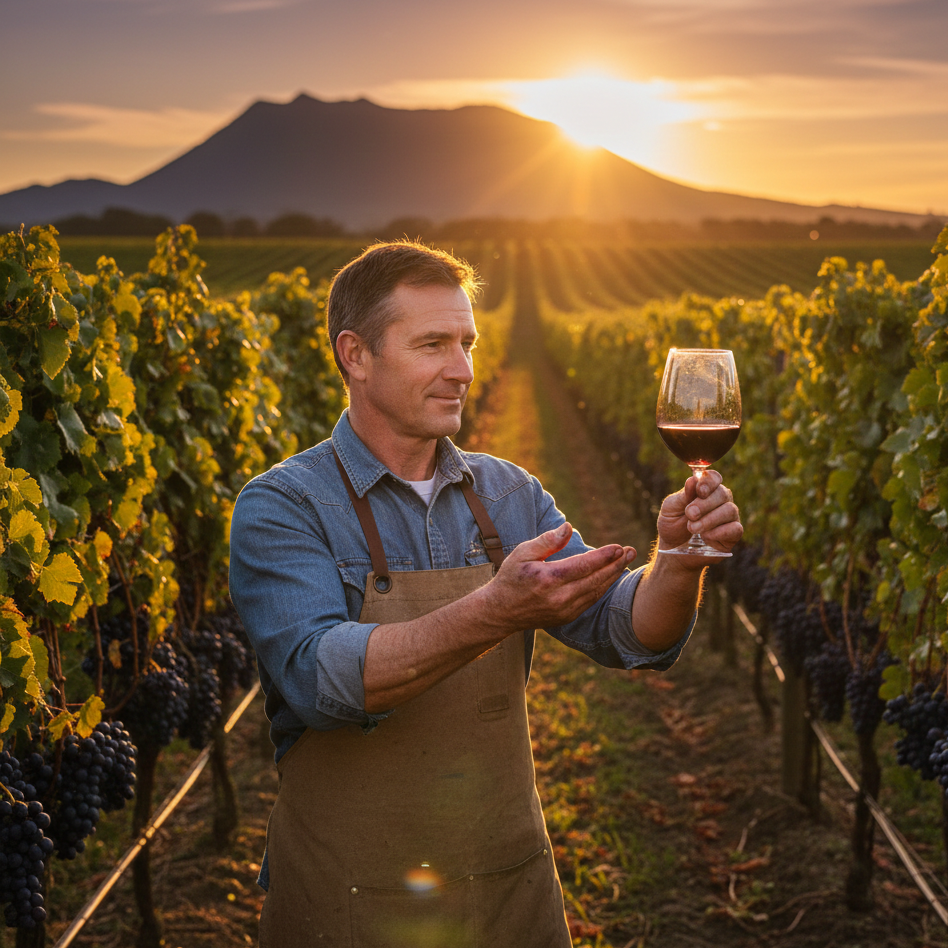
Dirt, Dew, and Degrees: A Winemaker’s View of New Zealand’s North Island
To a Sommelier, the North Island is a list of prestigious labels. To a winemaker, it is a battlefield of microclimates and a masterclass in soil management.
Having spent time in the cellars of Oregon, I look at the North Island through a different lens: I see the struggle of the vine against the humidity of Auckland, the heat-retention of the Gimblett Gravels, and the unforgiving winds of Martinborough. Here is what makes the North Island a winemaker’s playground.
1. The Geometry of the Gimblett Gravels (Hawke’s Bay)
In the winery, we talk about “thermal mass.” In the Gimblett Gravels, you feel it. This 800-hectare patch of an old riverbed is essentially a giant radiator.
- The Winemaker’s Challenge: You aren’t just managing fruit; you’re managing tannin ripeness. In these stones, Syrah and Merlot hit phenolic ripeness that other regions dream of.
- The Technique: We look for that “blue fruit” profile and cracked pepper note. The challenge is keeping the acidity vibrant despite the intense heat reflected from the greywacke stones.
2. The “Abeele” Clone and the Winds of Martinborough
Down south in Martinborough, the winemaking is artisanal and often brutal. The region is famous for the “Martinborough Terrace,” a free-draining alluvial soil.
- The Viticulture: It’s all about the wind. The “Roaring Forties” winds blow through the Cook Strait, naturally thinning the canopy and reducing crop yields.
- The Cellar: As winemakers, we love the “Abel” clone (often rumored to be a smuggled cutting from Domaine de la Romanée-Conti). It produces small, thick-skinned berries. In the fermenter, this gives us an incredible savory-to-fruit ratio—think forest floor, dried thyme, and dark cherry.
3. Maritime Management on Waiheke Island
Making wine on an island like Waiheke is a logistical puzzle. Everything—from the glass bottles to the harvesters—must be ferried in.
- The Terroir: The soils are ancient, weathered clays. For a winemaker, clay is a double-edged sword: it holds water well (great for dry summers) but can be difficult to manage during a wet harvest.
- The Result: The Cabernet blends here have a “supple” tannin structure that is unique to maritime climates. It’s about elegance and “iron-fist-in-a-velvet-glove” textures.
4. The Chardonnay Evolution in Gisborne
Gisborne is where New Zealand first saw the potential of Chardonnay. From a winemaking standpoint, the shift here has been from “big and buttery” to “linear and saline.”
- The Craft: We are seeing more indigenous (wild) yeast fermentations and the use of larger-format oak (puncheons) to let the coastal salinity shine through. It’s no longer about masking the fruit with oak; it’s about framing the sunshine.
The Winemaker’s Takeaway
Whether I am in the cellars of Oregon or tasting through a flight from Hawke’s Bay, the lesson is the same: The wine is made in the vineyard. The North Island proves that New Zealand isn’t a “one-trick pony.” It is a rugged, diverse landscape that demands everything from the person wearing the boots.