


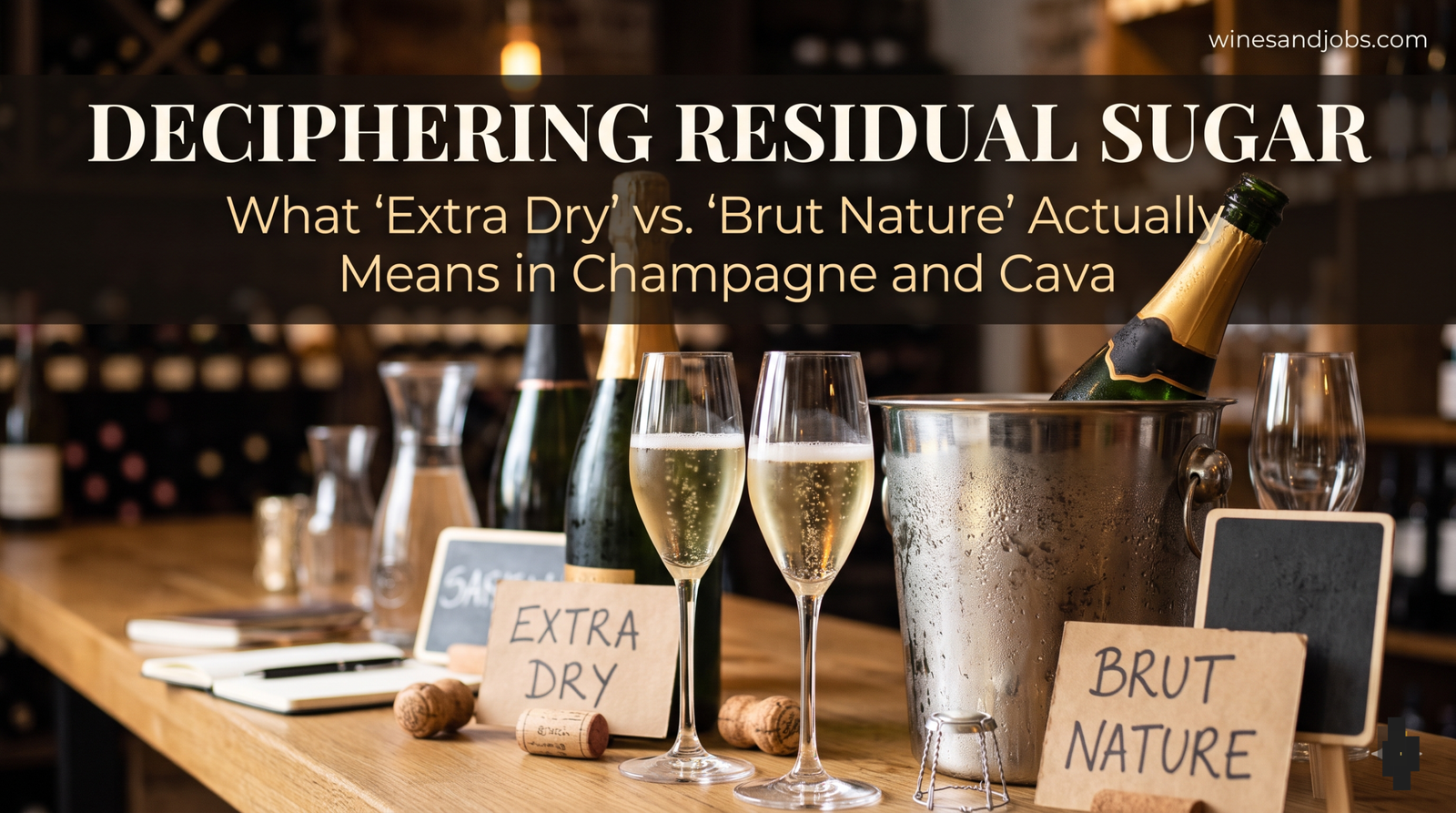
A bottle labeled “Extra Dry” contains noticeably more residual sugar than one labeled “Brut,” despite everyday language suggesting otherwise. In sparkling wines made via the traditional method (méthode traditionnelle)—most notably Champagne and Cava—sweetness is governed by strict legal classifications and fine-tuned by cellar biochemistry.
The Biochemistry of Dosage
Traditional-method sparkling wines undergo a secondary fermentation inside the sealed bottle, converting added sugar into carbon dioxide and alcohol until the wine ferments bone-dry (near 0 g/L residual sugar).
Disgorgement (Dégorgement): The neck of the bottle is flash-frozen to trap dead yeast cells (lees), and the crown cap is removed, allowing internal pressure to eject the sediment plug.
The Void & Acid Shock: Removing the sediment expels a small volume of wine. What remains is a base wine with piercing natural acidity (often a pH between 2.9 and 3.1) and carbonation up to 6 atmospheres. Left untouched, this level of malic and tartaric acid can taste aggressively austere.
Liqueur d’Expédition (Dosage): Winemakers top off the bottle with a customized blend of base wine, cane or beet sugar (sucrose), and occasionally sulfur dioxide.
Biochemical Hydrolysis & Integration: In the low-pH, acidic wine environment, sucrose molecules rapidly undergo acid-catalyzed hydrolysis, splitting into equal parts glucose and fructose. Fructose carries a higher perceived sweetness threshold than glucose or sucrose, subtly softening the sharp perceived bite of dissolved carbonic acid and tartaric acid without necessarily making the wine taste confectionery.
Decoding the Sweetness Scale
EU and international wine regulations standardize residual sugar (RS) brackets measured in grams per liter (g/L).
Sparkling wine sweetness classifications. Source: Wine Folly
| Category | Residual Sugar (g/L) | Sensory Profile & Sugar Caliber |
| Brut Nature / Zero Dosage | 0–3 g/L | No added sugar; austere, razor-sharp acidity, raw terroir expression |
| Extra Brut | 0–6 g/L | Crisp, mineral-driven; faint roundness on the mid-palate |
| Brut | 0–12 g/L | The industry standard; balanced acid-to-sugar ratio, versatile |
| Extra Dry / Extra Sec | 12–17 g/L | Counterintuitive naming: distinctly off-dry with noticeable fruit sweetness |
| Dry / Sec | 17–32 g/L | Moderately sweet; fruit compote notes, softer acidity |
| Demi-Sec | 32–50 g/L | Richly sweet; dessert territory, honeyed fruit notes |
| Doux | 50+ g/L | Candied, lush; historically favored in 19th-century European courts |
Note: European regulations permit a tolerance margin of ±3 g/L between the tested RS and the category threshold.
Why “Extra Dry” Isn’t Extra Dry
The naming discrepancy is a historical artifact of 19th-century taste evolution:
- During the 1800s, Champagne was routinely shipped with 50 to 150+ g/L RS to satisfy Russian and French palates.
- When British importers requested lighter, less cloying styles, houses cut sugar down to the 15–20 g/L range and branded it “Dry” or “Extra Dry” relative to the syrupy standard of the era.
- As tastes trended drier, winemakers developed even drier expressions, inventing the term Brut (meaning “raw” or “unrefined”) for bottles under 12 g/L. The older naming structure remained locked into wine law.
Food-Pairing Versatility Across the Spectrum
Understanding residual sugar levels allows sommeliers and servers to match wine acidity with culinary textures, fats, and spices:
Demi-Sec (32–50 g/L): Tailored for fruit tarts, lemon meringue, brioche-based bread puddings, and blue-veined cheeses like Roquefort or Gorgonzola Dolce. In dessert pairings, the wine must always be as sweet as or sweeter than the dish to keep it from tasting hollow and sour.
Brut Nature / Zero Dosage (0–3 g/L): Ideal for raw seafood, oysters on the half shell, sashimi, and tart goat cheeses. The lack of sugar highlights salinity and iodine minerality while slicing through briny textures.
Brut (0–12 g/L): The all-rounder for fried chicken, triple-cream brie, salty charcuterie, and potato chips. The trace dosage cushions the palate against high salt and dairy fat.
Extra Dry (12–17 g/L): The classic bridge for spicy cuisines (Thai curries, Sichuan peppercorn dishes, blackened fish) and salty-sweet bites (prosciutto-wrapped melon, glazed pork belly). Sugar acts as a natural cooling agent against capsaicin, which would otherwise make a zero-dosage wine taste bitter and uncomfortably alcoholic.