


In the winery, we often talk about sugar ($Brix$), alcohol, and tannins. But if you ask a winemaker which single number keeps them up at night, the answer is almost always pH.
pH is the “invisible backbone” of wine. It doesn’t just measure acidity; it dictates the wine’s color, its microbial safety, and how long it will last in your cellar. In 2026, as we face warmer harvests (see our Climate Adaptation blog), managing pH has become a high-stakes science from the moment the first bud breaks to the day the cork is driven home.
What is pH, Really?
Scientifically, pH measures the concentration of free-moving hydrogen ions in a liquid. It’s a logarithmic scale from 0 to 14:
- The Scale: Because it’s logarithmic, a wine with a pH of 3.0 is 10 times more acidic than a wine with a pH of 4.0.
- The Range: Most wines fall between 3.0 and 4.0.
- Whites: Typically 3.1–3.4
- Reds: Typically 3.4–3.8
The pH Journey: From Vine to Bottle
1. In the Vineyard (The Ripening Tug-of-War)
As grapes ripen, two things happen simultaneously: sugar goes up and acidity goes down.
- The Shift: Potassium from the soil moves into the berries, neutralizing acids and causing the pH to rise.
- The Goal: A vineyard manager’s job is to harvest when the pH is still low enough to provide “zip” but the flavors are fully developed. If you wait too long in a hot season, the pH can spike to 3.9 or 4.0, leaving the wine tasting “flabby” and flat.
2. During Fermentation (The Safety Shield)
pH acts as the primary “immune system” for your must.
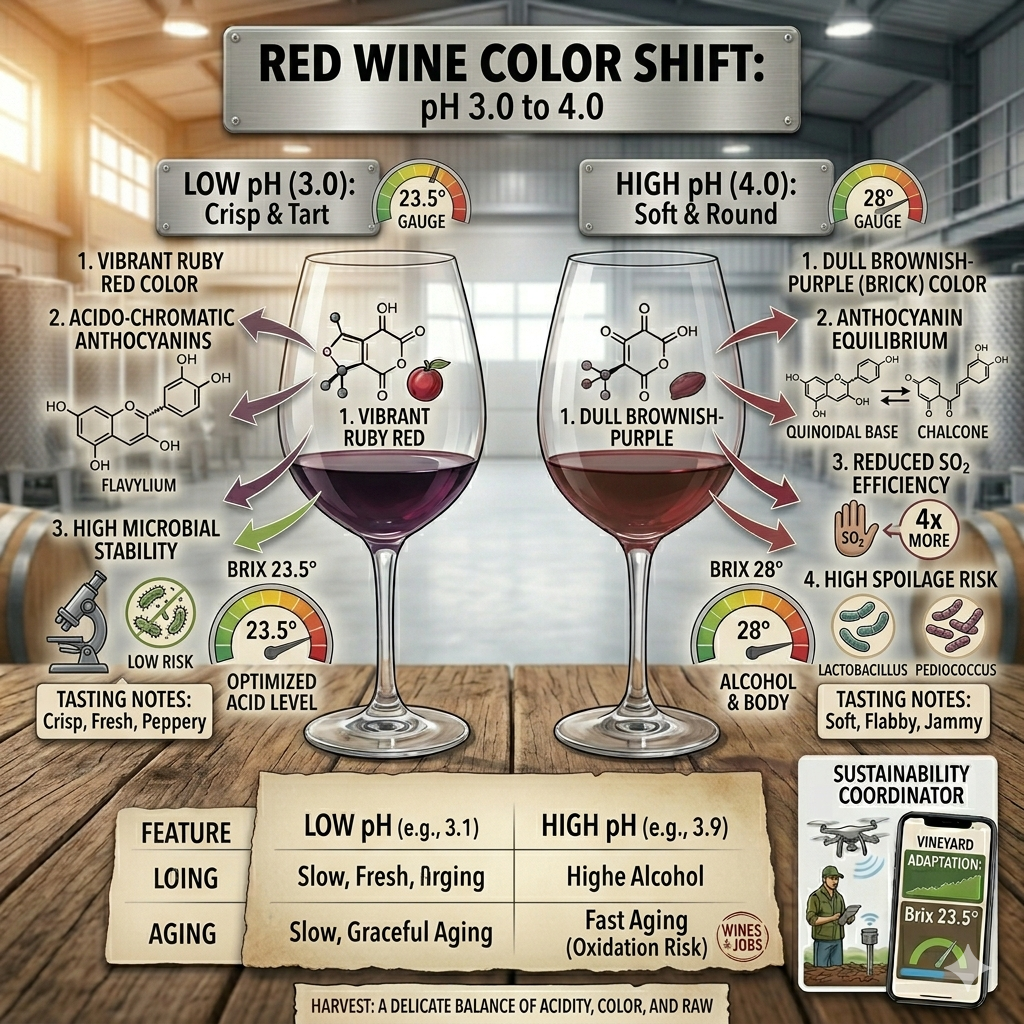
- Microbial Control: Spoilage bacteria like Lactobacillus and Pediococcus love high-pH environments ($>3.7$). Keeping the pH low creates a “hostile” environment for these “bad” microbes while allowing wine yeast to thrive.
- SO₂ Efficiency: Sulfur Dioxide (SO₂), the winemaker’s main preservative, is a slave to pH. At a pH of 3.2, you only need a tiny bit of SO₂ to protect the wine. At a pH of 3.9, you might need four times as much to achieve the same level of protection.
3. Post-Fermentation (Color and Stability)
For red wines, pH is a master artist.
- The “Red Shift”: At a lower pH (3.3–3.5), the color molecules (anthocyanins) stay in a vibrant, ruby-red state. As the pH rises toward 4.0, these molecules shift to a dull, brownish-purple or “brick” hue.
- Protein Stability: In white wines, a low pH helps proteins stay in solution. If the pH is too high, you risk “protein haze,” requiring more bentonite (clay) to fine and clear the wine.
The Winemaker’s Cheat Sheet: pH vs. TA
It’s important not to confuse pH with TA (Titratable Acidity).
- TA measures the quantity of acid (how sour it tastes).
- pH measures the strength of that acid (how the wine behaves chemically).
| Feature | Low pH (e.g., 3.1) | High pH (e.g., 3.9) |
| Taste | Crisp, Tart, Fresh | Soft, Round, “Flabby” |
| Color | Bright Red / Pale Straw | Deep Purple / Golden Brown |
| Safety | High Microbial Stability | High Risk of Spoilage |
| Aging | Slow, Graceful Aging | Fast Aging (Oxidation Risk) |
🍷 Published on Wines and Jobs
Connecting the global wine community through insight, expertise, and opportunity.
As climate change pushes harvest pH levels higher, the industry is desperate for Enologists and Cellar Managers who can master acid additions and microbial stability.
- Find Your Next Lab Role: Browse Jobs
- Master the Science: Join our community at www.winesandjobs.com for more deep dives into the chemistry of the crush.
Cheers !!!